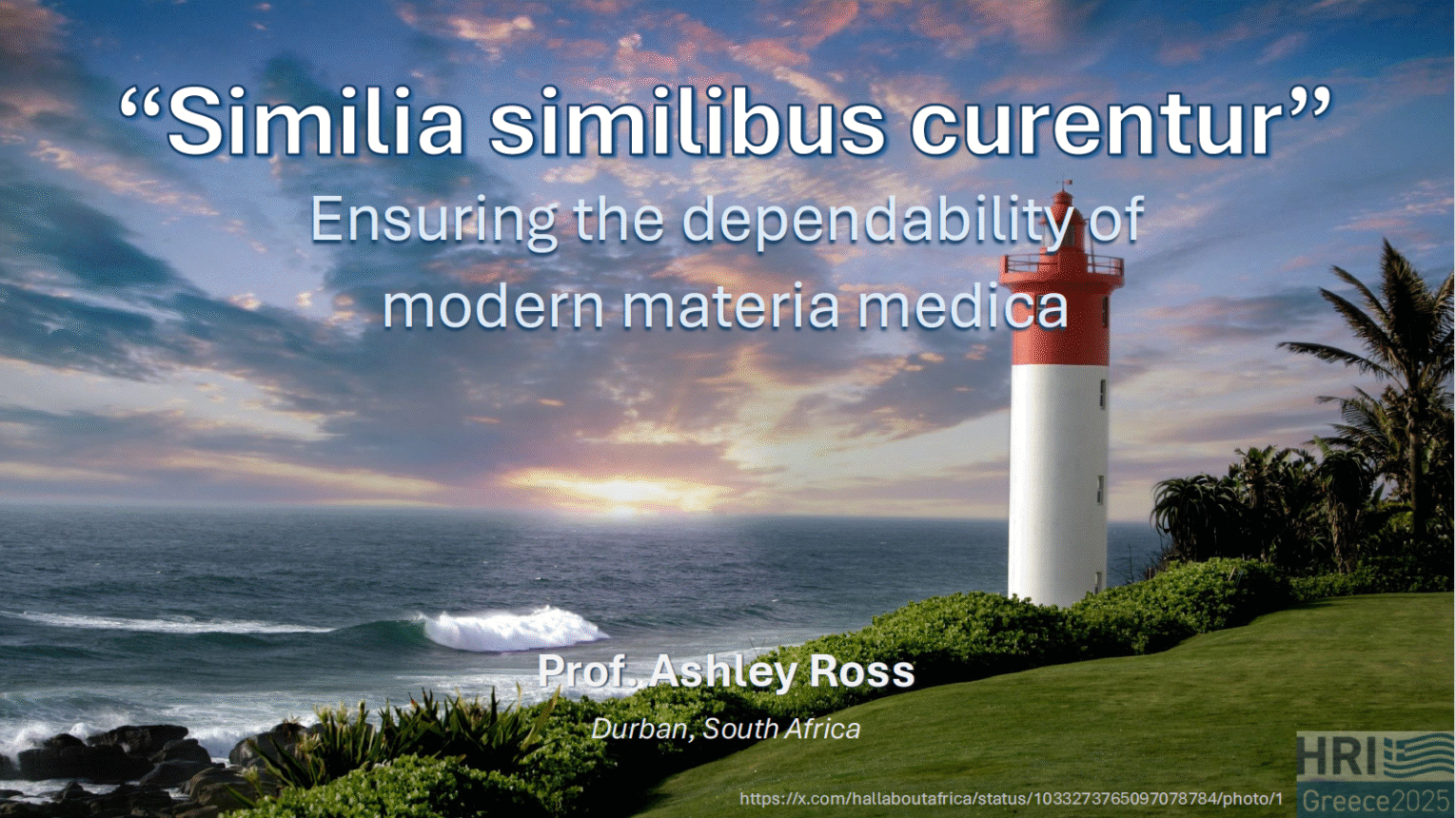
Over the next couple of weeks I’m going to share some information from a couple of presentations at the HRI conference. I’ve also written a report for the Homeopathic Society, so if you are a member you can read a summary of most of presentations when Homeopathica comes out in the next couple of weeks. This week and next though I will go more in depth into a couple of the presentations that I found fascinating.
One of my favourite presentations (to be fair, I have many favourites), was the initial presentation from Professor Ashley Ross of Durban University of Technology in South Africa. His presentation was titled Similia similibus curentur: Ensuring the dependability of modern materia medica.
This included a brief history of provings, starting with Hahnemann and his experience with cinchona bark as far back as 1790. Samuel Hahnemann proved 101 remedies, Constantine Herring added another 91 remedies, and he also acknowledged the work done by Jeremy Sherr who has proved over 40 remedies. The use of systems based homeopathy, initially Scholten’s Minerals and Elements using the periodic table to extrapolate themes, and in more recent time Plants through Scholten’s work and Michel Yakir’s Wondrous Ordour.
Professor Ross also shared his extensive personal experience with homeopathy: placebo-controlled, double blinded homeopathic provings, dream provings and C4 provings, doctoral studies, provings for creating pharmacopoeia monographs, and part of a team developing the LMHI_ECH Guidelines for Homeopathic Provings (2014).
There were seven clear points that he stated are important for provings:
The source of the material must be clearly identified. For a plant this would include where it was gathered from, the part of the plant used and when and how it was collected.
If the remedy is to be replicated it also needs to be prepared in accordance with standards of the pharmacopoeia, and the potency clearly recorded.
An example of an animal source, Heliaeetus leucocephalus, the American Bald Eagle, the sample was taken from a bird in captivity with a broken wing. Would this be different to that of a wild bird?
Blinding and controls – if participants are told in a proving that some provers will receive placebo, it may make them more discerning in the way they record. In addition provers need to keep a diary both before and after the proving. The blank remedy should still have (non medicated) ethanol from the same batch in the same concentration to make the only difference the lack of the remedy in the medicating potency.
The methodology used for the proving should be well described, like for a scientific study. This should include age range, any inclusion or exclusion criteria, the potency used and number of doses given, the duration of the experimental phase but also the time before and after. In addition to this the management aspects including any supervisors, recording, adverse effects and any interventions, should be recorded.
There are now Guidelines from the Central Council for Research in Homeopathy in India, the LMHI and ECH Homeopathic Proving Guidelines, and HPUS (the Homeopathic Pharmacopoeia of the US) also have Guidelines which include information required for a monograph in the Pharmacopoeia.
Training and experience for the proving team is important, to allow adequate assessment of the quality of prover journaling before this is included in the remedy monograph.
It needs to be clear that the effect of the remedy is due to the drug itself. He cited a recent proving conducted during the Covid pandemic which had symptoms of anxiety, delusions attacked, banished and insane, and a fear of contagious disease. With the experience of Covid around the world, were these symptoms due to the remedy, or just the context of the time it was proved?
Ideally we should be able to trace the rubrics we use back to the original journal entry to ensure the validity of the data. This means there are a lot of steps to go through to turn the raw proving data into both Materia Medica, and Repertory entries. Including editing the journal and comparing provers, then writing the Materia Medica, and then allocating rubrics, listing these, considering grading (how strong the symptom is) and then this can be added to our repertories.
Symptoms when included need to be homeopathically useful, distinctive, well described, and represent an alteration from the normal healthy state.
He noted that traditional provings provide a comprehensive and reproducible picture. While C-4 trituration can provide a shortcut to gaining information, it can lack specificity in the symptoms.
Publication needs to include a detailed description of the remedy source, potencies employed and the proving methodology. Materia Medica needs to be well organised, and a clear summary of the remedy will help with clinical application.
In conclusion, what Professor Ross called his “lines in the sand” about provings were:
While it is important to be enthusiastic, we also need a higher burden of proof to ensure that our remedies are clinically useful, and able to be re-proved and re-sourced when the original source material is exhausted.
Different methodologies can have different purposes, outcomes and clinical outcomes
But at all stages of the proving we need to be accountable and precise.
Use proving guidelines (and be clear about which one) and discernment and judgement when choosing sources.
Safe guard our ability to use these remedies by ensuring there is a clinically applicable effect on the health of the individual provers.
This presentation was excellent, and then I was fortunate enough to, quite by chance, end up sitting at the same table as Professor Ross at the dinner that night. He told me about his PhD thesis, where he undertook a proving of a native plant, collected blood samples for analysis, and then also spoke to Zulu healers to ask their experiences of using that substance in healing. The exact parallels between the experience of the sensations of the provers, and the reasons the Zulu healers used the remedy for certain conditions was striking. I also spoke with him about my interest in proving New Zealand remedies, and how New Zealand is in a unique position with the Waitangi Tribunal Wai 262 decision and our ability to undertake provings.
I have been saying for a couple of years that I would like to work on proving New Zealand plant remedies, and this presentation and my discussion with Professor Ross at dinner has given me much food for thought. He sent me a copy of his PhD Thesis to read, and I have already had a brief look and comparison at the three different Proving Guidelines to assess which one would be best for me, and now I need to work on taking this to the next step. Watch this space, hopefully next year I will be looking for participants in a proving!