One of the wonderful, but sometimes also difficult things about homeopathy is the many many ways of analysing a case and coming up with different remedies. While sometimes there is an agreement on a particular remedy, many times in groups of Homeopaths you can present a case you are having difficulty with and you may get 6 different remedies from 6 different Homeopaths. I have come to the conclusion that as much as homeopathy is individualised for the client, it is also individual to the Homeopath, and this is why you need to find the right person that you ‘click’ with.
I like finding out about all the different types of tools to analyse cases. This is great because when I get a complex case that doesn’t respond to my usual tools, I have the ability to switch and try something different. I’ve found my success rate is much higher now that I have this flexibility, even if it does take some persistence on both sides!
One method that I came across a few years ago is Homeopathic Facial Analysis. It was developed in Australia by Grant Bentley and involves looking at the face – from the front and in profile – and specifically analysing different features.
Before I discuss how this works, we first need to have a catch up on what a miasma is. I did an entire series on this a couple of years ago which you can find on my website, just search for ‘miasm’ and the ten posts should come up.
Briefly though, a miasm is your inherited tendency to disease, and the way that dis-ease manifests in you. This is not quite the same as epigenetics – which is the interplay between environment and genetics – although there are similarities. With chronic and constitutional homeopathic treatment we consider the miasms for the person, sometimes using the nosode from a particular miasm either as a remedy or as a support, and sometimes using this to select an appropriate remedy from what is available.
Hahnemann recognised three miasms – Psora, Sycosis and Syphilis, and over the years other miasms have been added, but the most commonly considered ones are tuberculosis and cancer.
In Homeopathy Facial Analysis (HFA), the miasms have been given a colour code – Yellow – Psora
Green – Tubercular
Blue – Syphilitic
Purple – Syco-syphilis
Red – Sycosis
Orange – Syco-psora
Brown – Cancer
This helps with the categorising of the facial features, and then determining what is the correct miasm and appropriate remedy from there. As you can see, there are not just the 5 miasms we are most familiar with, but also syco-syphilis and syco-psora to bridge the different miasms.
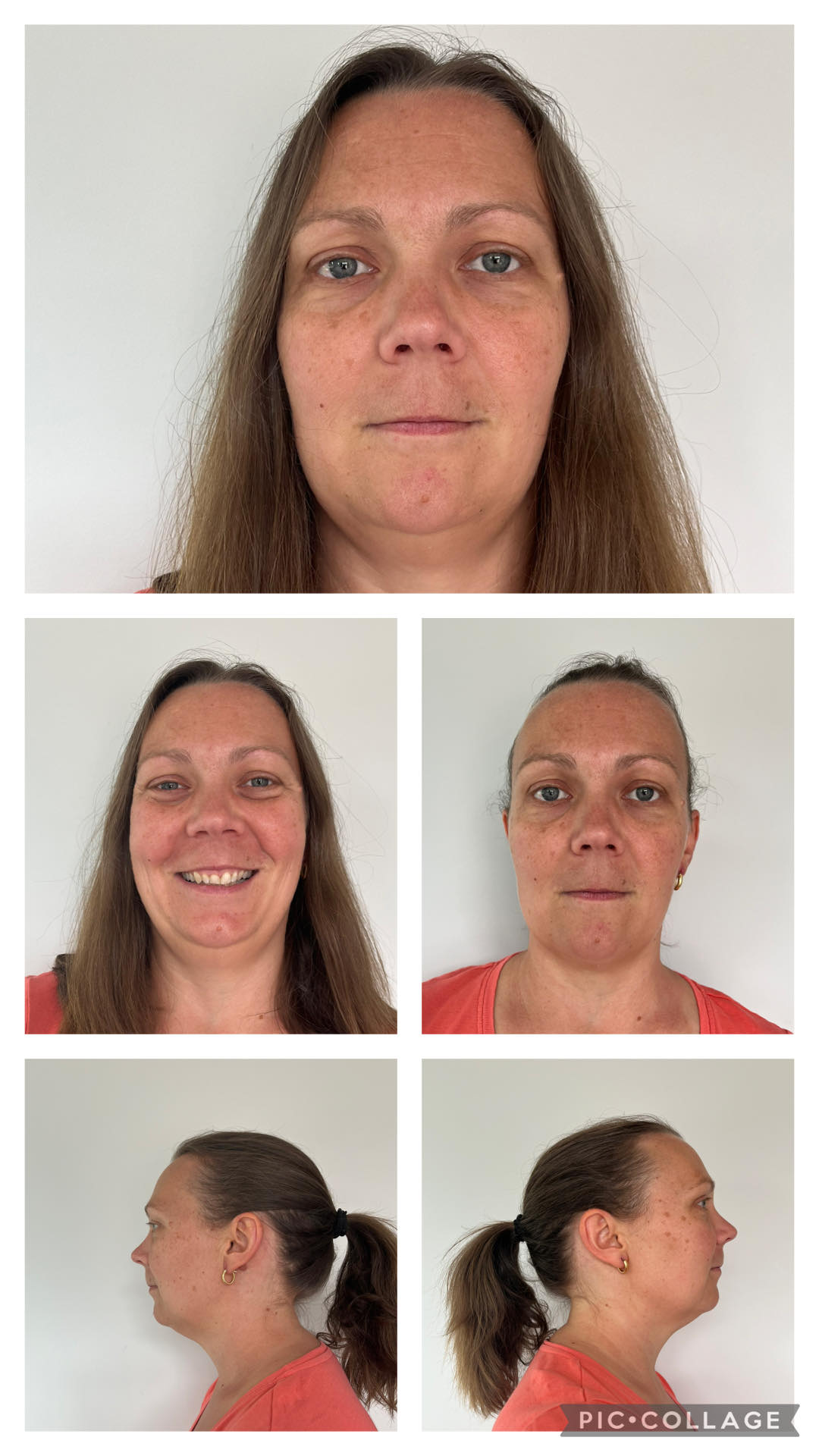
To do Homeopathic Facial Analysis, you take five separate photos:
- Straight on with a relaxed mouth
- Straight on with a broad smile
- Straight on with hair pulled back so the full forehead can be seen
- Profile from the left
- Profile from the right
They need to hold their head straight, and the photo be close up so that all aspects of the face can be seen.
The photo is then analysed by comparing it to a list of features. If you have a particular feature, that is checked, and it will correspond to either red, blue or yellow. At the end, you add up the numbers in the different columns, and then use this to determine what colours are most prevalent, and therefore what is the dominant miasm.
This includes hairline, forehead, eyes, ears, nose, shape of the profile, mouth including lips and teeth, chin, any lines and features of the skin. That sounds like a lot, but most faces have 8-14 items that are prominent enough to be included – and they state that if you are in doubt you leave it out.
Before using this with clients, I tested it on some colleagues – it was fun, and very accurate. This gave me the confidence to use it with clients. I don’t do this routinely in my practice, however I have found it useful on a few occasions when I couldn’t get a good handle on what the miasm was and we needed support in a different way.
Way outside my comfort zone, you can see a collage of my photos here so you can look at some of the different features I have.
Cowlicks are not one of the features (although as someone who has two I think they should be!)
The things that I note about myself is a high hairline (B), with a sloped back forehead (Y).
My lips are thin (Y) and my nose could fall into the ‘ski jump’ profile (R).
I have an overbite (B).
I can see my forehead lines (Y), and I have moles (R).
I have a chin dimple (R), and dimples/lines in my cheeks when smiling (B).
Other people may see other things as well, I found it really hard to objectively analyse my own face!
What this nets me is 3 Blue, 3 Yellow and 3 Red, which puts my firmly in the Cancer miasm. Interestingly I have a strong family Tubercular history, but one of my children does really well on Carcinosin – maybe it’s time I took a dose also.
What do you think about Homeopathic Facial Analysis? Is this something you would want to try? For Homeopaths and students, if you want to learn more the Homeopathic Society have one copy of the latest book, the HFA Workbook by Louise Bentley, which is more up to date than the book I have been using. You can buy it here (and if someone else beat you to it, you can always request a copy!)